

Target Pain and Inflammation with MLS Laser Therapy Now


Table of Contents
Target Pain and Inflammation with MLS Laser Therapy
Abstract
As a clinician with diverse credentials spanning chiropractic, nursing, and functional medicine, I am passionate about integrating cutting-edge, evidence-based therapies to achieve superior patient outcomes. This post explores the science and application of Multiwave Locked System (MLS) Laser Therapy, a powerful modality for managing pain and inflammation and accelerating tissue repair. We will explore the underlying physiological mechanisms, from mitochondrial stimulation to inflammatory modulation, and discuss how this technology is transforming patient care.
Drawing on insights from leading researchers and my own clinical observations, I will detail how we apply MLS laser therapy for conditions such as low back pain and osteoarthritis, and how we use it in conjunction with regenerative medicine procedures such as Platelet-Rich Plasma (PRP). I will also explain how this non-invasive treatment integrates seamlessly into a holistic, integrative chiropractic care model, addressing both the symptoms and the root cause of dysfunction.
Patient-Centered Application: A Low Back Pain Demonstration
In any therapeutic application, patient comfort is paramount. This is especially true when using advanced technology such as a robotic MLS laser. A comfortable and stable patient ensures that the laser energy is delivered precisely to the targeted tissues. If a patient shifts or moves, the carefully calculated treatment area can be compromised, reducing the therapy’s effectiveness.
Let’s walk through a typical setup for a patient presenting with low back pain and stiffness. In our practice, we recently had a patient, John, who was experiencing these exact symptoms, localized to the L4-L5 facet joints, with some referred sensation down his right side.
- Positioning: We had John lie face down on the treatment table. This position provides excellent access to the lumbar spine and paraspinal muscles. It’s crucial that the laser is applied directly to the skin for optimal energy penetration.
- Identifying the Target: I asked John to pinpoint the primary area of his discomfort, which he identified as just medial to the right L4-L5 region. This subjective feedback is invaluable for centering the treatment.
- Robotic Setup: The M6 robotic laser is an incredible tool. I begin by zeroing out the X and Y axes, which defines the perimeter of the treatment area. I then position the robotic head directly over the epicenter of John’s pain. From there, I can expand the treatment field.
This brings us to a key concept in our practice: the clinical multimodal approach. We don’t just treat the “spot of pain.” Pain is often a symptom of a broader dysfunction. By expanding the laser’s treatment area, we can address not only the primary site of pathology but also the surrounding connective tissue, fascial planes, and compensating muscle groups. It’s a more global strategy that aims to address the root cause of the issue and the entire kinetic chain involved.
The Science of Dosage and Delivery: Energy Density vs. Total Joules
A common point of confusion in photobiomodulation (laser therapy) is the concept of dosage. Many focus on the “total joules” delivered, but modern research, supported by organizations such as the World Association for Laser Therapy, emphasizes the importance of energy density, measured in joules per square centimeter (J/cm²).
Energy density is the concentration of energy delivered to a specific area. Think of it like watering a plant. Drenching a single small spot with a gallon of water isn’t as effective as distributing that same gallon evenly across the entire root system. The body’s tissues have a therapeutic window for absorbing light energy.
- Our goal is to achieve an energy density of 4-10 J/cm². This range is consistently reported in the literature as the sweet spot for eliciting a therapeutic biological response without “overcooking” the tissue.
- For John’s low back pain, the protocol was set to deliver 6 J/cm², which, over the course of his 8-minute session, would equate to approximately 800-900 total joules.
- A significant advancement in the M6 laser’s software is its ability to automatically adjust the treatment time when we change the treatment area size (the X and Y axes). If we make the area smaller or larger, the machine recalculates the time needed to deliver that precise 6 J/cm² dose, ensuring consistent and optimal treatment every time.
The Dual-Wavelength Advantage of MLS Laser Therapy
What makes MLS Laser Therapy so unique is its patented technology that delivers two different wavelengths of light simultaneously:
- 808 nanometer (nm) Continuous Wave: This wavelength is primarily absorbed by the tissue, where it has a powerful anti-inflammatory and anti-edemic (swelling-reducing) effect.
- 905 nanometer (nm) Super-Pulsed Wave: This wavelength has a strong analgesic (pain-relieving) effect. Because it’s delivered in extremely short, powerful pulses (measured in nanoseconds), it can penetrate deeper into tissue to reach structures such as nerve endings and deeper muscle layers without generating heat.
The “secret sauce” is the synchronized delivery. The M6 robotic laser has a peak power of 50 watts. It delivers this high power in short, intense pulses at 905 nm, followed by a period of rest. This allows the tissue to absorb the energy fully without overheating. When tissue temperature remains constant during treatment, we know we are delivering the right amount of energy, at the right wavelengths, at the right pace and dose.
You can actually visualize part of this process. If you look at the treatment area through your phone’s camera, you’ll see a distinct triangle of light. This is the 808 nm wavelength at work. The 905 nm wavelength pulses are too quick for the camera to capture, but they’re being delivered to that same area, providing a one-two punch against pain and inflammation.
Dual Application: Robotic and Handheld Piece
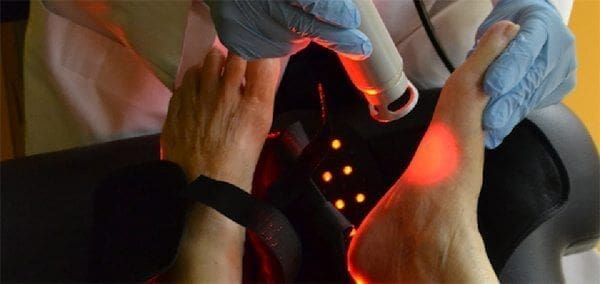
The MLS system offers incredible versatility. While the robot treats a broad area, we can simultaneously use a handheld applicator on the same patient. The handpiece has one diode and is designed for direct skin contact, whereas the robot’s three diodes allow it to be positioned about six inches away.
This dual-modality approach is perfect for a comprehensive treatment. While the robot was addressing John’s general lumbar region, I used the handpiece to target specific trigger points in his paraspinal and gluteal muscles. Trigger points are hyperirritable nodules in the fascia surrounding skeletal muscle; I often refer to them using an analogy a physical therapist once taught me: I’m searching for the “cooked meat” (the tight knot) within the “raw meat” (the soft, pliable muscle). Applying the laser directly to these points for 25-30 seconds each helps to release the knot and restore normal muscle function. This is a perfect example of how chiropractic manual therapy principles merge with advanced technology.
From Acute to Chronic: The Physiological Cascade
A frequent and excellent question I receive is how laser therapy works on both acute and chronic conditions and what the timeline of effects looks like. It’s not as if we can select “anti-inflammatory mode” or “mitochondrial mode.” All effects are initiated simultaneously, but they manifest over different time frames.
The Immediate (Acute) Effect: Pain Modulation
The quick relief some patients feel can be attributed to the laser’s effect on nerve fibers. The energy can temporarily reduce the excitability of small, C-type pain fibers, essentially turning down the “pain volume.” This is an immediate, neurophysiological effect that can provide comfort within hours of the first treatment. As one of our lead researchers noted, the patient should assess their pain approximately 4 to 6 hours post-treatment. For John, that would be around 5 PM on the day of his 11 AM session. This initial analgesic effect is encouraging and helps with patient compliance.
The Intermediate Effect: Inflammatory and Immune Modulation
Over the course of several treatments, we tap into the powerful anti-inflammatory effects. The laser energy influences cellular mediators of inflammation, helping to clear out inflammatory byproducts and reduce swelling. This isn’t about suppressing inflammation entirely, as a certain amount is necessary for healing. Instead, it’s about modulating the process to make it more efficient and prevent it from becoming chronic and destructive.
The Long-Term (Chronic) Effect: Mitochondrial Optimization and Tissue Regeneration
This is where the magic of cellular healing truly happens. The photons of light energy are absorbed by cytochrome c oxidase, an enzyme within the mitochondria (the “powerhouses” of our cells). This absorption kicks off a cascade of events:
- It boosts the production of Adenosine Triphosphate (ATP), the cell’s primary energy currency. More ATP means cells have more energy to perform their functions, including repair and regeneration.
- It increases the production of Nitric Oxide (NO), a potent vasodilator. This improves local blood circulation, bringing more oxygen and nutrients to the injured area and removing waste products.
- It stimulates mitochondrial biogenesis—the creation of new mitochondria. A cell with more mitochondria is more resilient and has a greater capacity for healing.
This mitochondrial optimization is crucial for chronic conditions. Many of my patients are on medications like statins or metformin, which can negatively impact mitochondrial function. Laser therapy can help offset this by directly stimulating ATP production and mitochondrial health, preparing the cellular environment for profound healing. This is a foundational concept in functional medicine: optimizing cellular function is the key to resolving systemic issues.
Integrating MLS Laser with Regenerative Medicine and Chiropractic Care
One of the most exciting frontiers is the synergy between MLS Laser Therapy and orthobiologics, such as Platelet-Rich Plasma (PRP) injections. PRP works by concentrating growth factors from a patient’s own blood to stimulate a healing response. However, the success of PRP depends on the health of the “soil”—the cellular environment into which it’s injected.
Based on provider-driven protocols and emerging research, we have found that an enhanced protocol yields the best results:
- Pre-Injection Priming: We recommend two to three laser sessions before the PRP injection. This “prepares the soil” by reducing local inflammation, increasing blood flow, and optimizing mitochondrial function in local cells. This creates a more receptive and robust environment for the injected growth factors to work.
- Day of Injection: A laser treatment on the day of the procedure can further enhance circulation and begin to modulate the intense inflammatory response that PRP is designed to create. The laser doesn’t blunt this necessary inflammation; it helps the body manage it more effectively.
- Post-Injection Support: Six subsequent laser treatments help support the regenerative process, manage pain, and guide the tissue toward optimal repair.
The data is compelling. We estimate that adding this MLS laser protocol to a PRP treatment plan can increase efficacy by 15-20% over PRP alone.
The Role of Integrative Chiropractic Care
This is where the integrative model truly shines. As a chiropractor, my primary tool is the adjustment, which restores proper joint mechanics and nervous system function. By combining this with MLS laser therapy, we can address the body on multiple levels:
- Structural: Chiropractic adjustments correct biomechanical faults and reduce stress on joints and nerves.
- Cellular: MLS Laser Therapy provides the cellular energy and an optimized environment needed for tissues to heal from damage caused by structural faults.
- Functional: As pain and inflammation decrease and joint function is restored, we introduce targeted rehabilitative exercises to rebuild strength and stability, preventing re-injury.
This comprehensive approach allows us not only to relieve patients’ pain but also to build a more resilient, optimized state of health, potentially delaying or even avoiding the need for more invasive procedures like surgery. For a condition like “bone-on-bone” knee osteoarthritis, while the laser cannot regrow cartilage, it can significantly manage the pain and inflammation, allowing a patient to maintain an active, high-quality lifestyle for much longer.
Treatment Protocols and Patient Expectations
Healing is a process, not a single event. A condition that has developed over the years will not be resolved in a single 10-minute session. Setting clear expectations is crucial for patient success.
- Acute Conditions: We typically recommend a course of six treatments.
- Chronic Conditions: A course of 12 treatments is standard.
The goal is to complete these treatments as quickly as possible, with a minimum of 24 hours between sessions. A common schedule is three times per week (e.g., Monday, Wednesday, Friday). The effects are cumulative; each session builds upon the last. This is why we sell treatments in packages. We don’t want a patient to stop after three or four sessions simply because they are starting to feel better. Completing the full protocol is essential to achieve lasting cellular change and prevent a relapse.
Ultimately, MLS Laser Therapy is a cornerstone of my integrative practice. It is a non-invasive, safe, and powerful tool that empowers us to work with the body’s innate healing intelligence. By addressing pain, inflammation, and cellular energy production, we can guide our patients on a journey from dysfunction and pain to optimized health and vitality.
References
- Al-Quisi, A. F. (2020). Assessment of low-level laser therapy in the treatment of post-extraction pain. Journal of Oral and Maxillofacial Surgery, 78(9), 1500-1505. https://doi.org/10.1016/j.joms.2020.04.025
- Cotler, H. B., Chow, R. T., Hamblin, M. R., & Carroll, J. (2015). The use of low level laser therapy (LLLT) for musculoskeletal pain. MOJ Orthopedics & Rheumatology, 2(5). https://doi.org/10.15406/mojor.2015.02.00068
- de Freitas, L. F., & Hamblin, M. R. (2016). Proposed mechanisms of photobiomodulation or low-level light therapy. IEEE Journal of Selected Topics in Quantum Electronics, 22(3), 348-364. https://doi.org/10.1109/JSTQE.2016.2561201
- World Association for Laser Therapy (WALT). (n.d.). Dosage recommendations. Retrieved May 2, 2026, from their official website. (Note: A direct link to WALT dosage pages would be inserted here if available, as the site structure changes).
Post Disclaimer
Professional Scope of Practice *
The information on this blog site is not intended to replace a one-on-one relationship with a qualified healthcare professional or licensed physician and is not medical advice. We encourage you to make healthcare decisions based on your research and partnership with a qualified healthcare professional.
Blog Information & Scope Discussions
Welcome to El Paso's Premier Wellness and Injury Care Clinic & Wellness Blog, where Dr. Alex Jimenez, DC, FNP-C, a board-certified Family Practice Nurse Practitioner (FNP-BC) and Chiropractor (DC), presents insights on how our team is dedicated to holistic healing and personalized care. Our practice aligns with evidence-based treatment protocols inspired by integrative medicine principles, similar to those found on this site and our family practice-based chiromed.com site, focusing on restoring health naturally for patients of all ages.
Our areas of chiropractic practice include Wellness & Nutrition, Chronic Pain, Personal Injury, Auto Accident Care, Work Injuries, Back Injury, Low Back Pain, Neck Pain, Migraine Headaches, Sports Injuries, Severe Sciatica, Scoliosis, Complex Herniated Discs, Fibromyalgia, Chronic Pain, Complex Injuries, Stress Management, Functional Medicine Treatments, and in-scope care protocols.
Our information scope is limited to chiropractic, musculoskeletal, physical medicine, wellness, contributing etiological viscerosomatic disturbances within clinical presentations, associated somato-visceral reflex clinical dynamics, subluxation complexes, sensitive health issues, and functional medicine articles, topics, and discussions.
We provide and present clinical collaboration with specialists from various disciplines. Each specialist is governed by their professional scope of practice and their jurisdiction of licensure. We use functional health & wellness protocols to treat and support care for the injuries or disorders of the musculoskeletal system.
Our videos, posts, topics, subjects, and insights cover clinical matters and issues that relate to and directly or indirectly support our clinical scope of practice.*
Our office has made a reasonable effort to provide supportive citations and has identified relevant research studies that support our posts. We provide copies of supporting research studies available to regulatory boards and the public upon request.
We understand that we cover matters that require an additional explanation of how they may assist in a particular care plan or treatment protocol; therefore, to discuss the subject matter above further, please feel free to ask Dr. Alex Jimenez, DC, APRN, FNP-BC, or contact us at 915-850-0900.
We are here to help you and your family.
Blessings
Dr. Alex Jimenez DC, MSACP, APRN, FNP-BC*, CCST, IFMCP, CFMP, ATN
email: [email protected]
Licensed as a Doctor of Chiropractic (DC) in Texas & New Mexico*
Texas DC License # TX5807
New Mexico DC License # NM-DC2182
Licensed as a Registered Nurse (RN*) in Texas & Multistate
Texas RN License # 1191402
ANCC FNP-BC: Board Certified Nurse Practitioner*
Compact Status: Multi-State License: Authorized to Practice in 40 States*
Graduate with Honors: ICHS: MSN-FNP (Family Nurse Practitioner Program)
Degree Granted. Master's in Family Practice MSN Diploma (Cum Laude)
Dr. Alex Jimenez, DC, APRN, FNP-BC*, CFMP, IFMCP, ATN, CCST
(Board Certified: Family Practice Nurse Practitioner—Multistate)*
(Licensed Nurse Practitioner & Chiropractor - Multistate)*
Clinical Director
Digital Business Card
Dr. Maria Cardenas, MD
(Board Certified: Internal Medicine)
(Licensed Medical Doctor)
Medical Director, Clinical Director & Collaborative Physician
NPI # 1164426748
MD License #: J2933
Licenses and Board Certifications:
MD: Medical Doctor
DC: Doctor of Chiropractic
APRNP: Advanced Practice Registered Nurse
FNP-BC: Family Practice Specialization (Multi-State Board Certified)
RN: Registered Nurse (Multi-State Compact License)
CFMP: Certified Functional Medicine Provider
MSN-FNP: Master of Science in Family Practice Medicine
MSACP: Master of Science in Advanced Clinical Practice
IFMCP: Institute of Functional Medicine
CCST: Certified Chiropractic Spinal Trauma
ATN: Advanced Translational Neutrogenomics
Memberships & Associations:
TCA: Texas Chiropractic Association: Member ID: 104311
AANP: American Association of Nurse Practitioners: Member ID: 2198960
ANA: American Nurse Association: Member ID: 06458222 (District TX01)
TNA: Texas Nurse Association: Member ID: 06458222
NPI: 1205907805
| Primary Taxonomy | Selected Taxonomy | State | License Number |
|---|---|---|---|
| No | 111N00000X - Chiropractor | NM | DC2182 |
| Yes | 111N00000X - Chiropractor | TX | DC5807 |
| Yes | 363LF0000X - Nurse Practitioner - Family | TX | 1191402 |
| Yes | 363LF0000X - Nurse Practitioner - Family | FL | 11043890 |
| Yes | 363LF0000X - Nurse Practitioner - Family | CO | C-APN.0105610-C-NP |
| Yes | 363LF0000X - Nurse Practitioner - Family | NY | N25929 |
Dr. Alex Jimenez, DC, APRN, FNP-BC*, CFMP, IFMCP, ATN, CCST
(Board Certified: Family Practice Nurse Practitioner—Multistate)*
(Licensed Nurse Practitioner & Chiropractor - Multistate)*
Clinical Director
Digital Business Card
Dr. Maria Cardenas, MD
(Board Certified: Internal Medicine)*
(Licensed Medical Doctor)*
Medical Director, Clinical Director & Collaborative Physician
NPI # 1164426748
MD License #: J2933

Comments are closed.